Airport Train vs Private Transfer: Which Is Better for Your Trip?
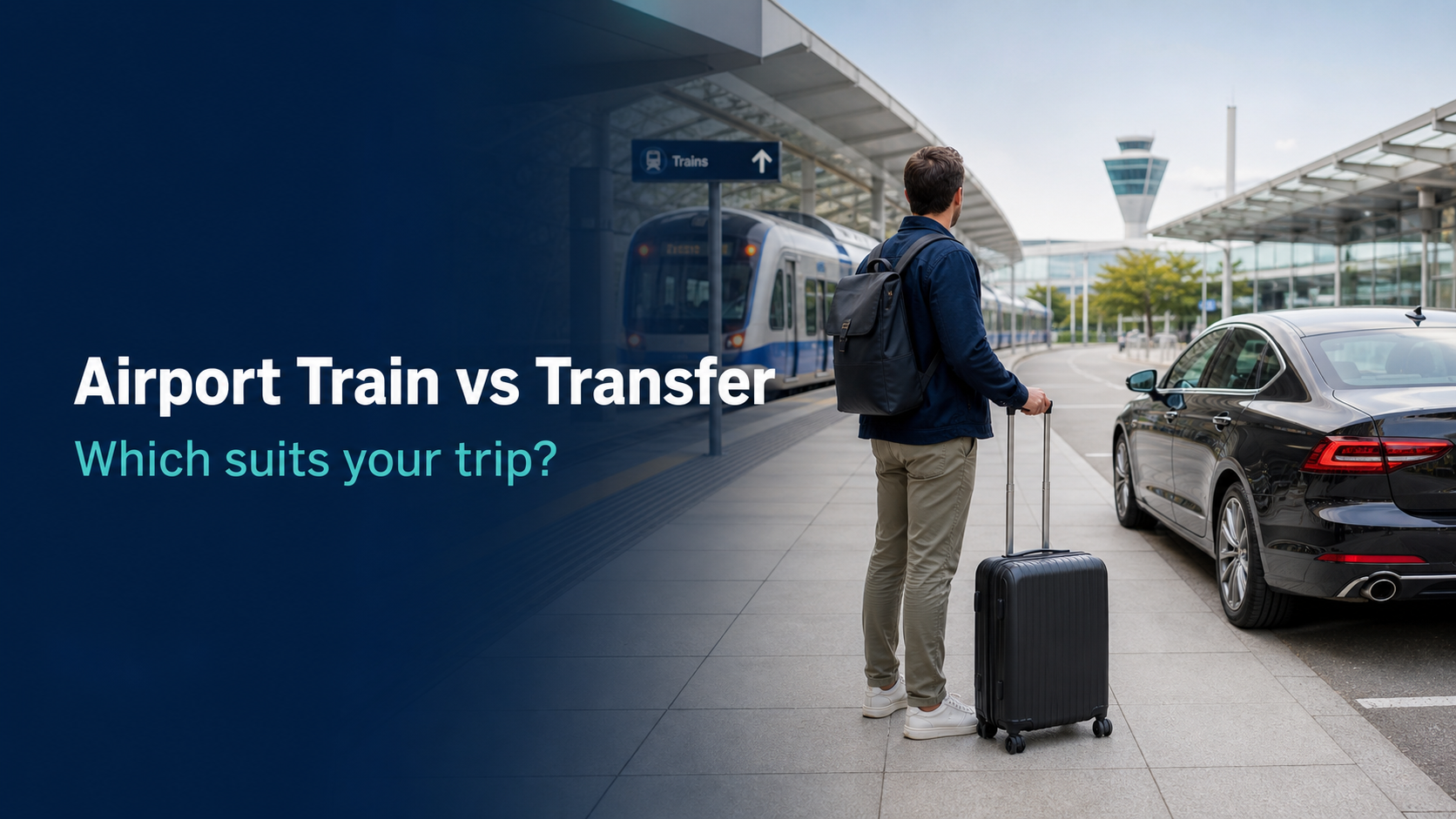
Airport transport comparison
Airport Train vs Private Transfer: Which Is Better for Your Trip?
The train often wins on solo ticket price. A private transfer can win on doors, bags, groups, timing and simplicity.
Quick answer: choose the airport train when the route is direct, the timetable suits and you can comfortably manage your luggage. Consider a private transfer when the journey involves connections, several passengers, young children, heavy bags, a tight schedule or a destination beyond the rail network.
Airport trains and private transfers solve different problems. A train moves passengers efficiently along a fixed corridor. A private transfer connects the terminal directly with a specific address. Comparing only the advertised fare misses the walking, connections, luggage handling and waiting that make up the complete journey.
The right answer changes by city and by traveller. Sydney has rail stations at the airport terminals. Other Australian airports use different combinations of rail, bus and coach services. Timetables, access charges and pickup arrangements can change, so confirm current details with the airport or transport operator before departure.
The short comparison
| Factor | Airport train | Private airport transfer |
|---|---|---|
| Route | Station to station | Door to door |
| Best-value case | Solo traveller on a direct route | Group sharing one suitable vehicle |
| Luggage | Passenger handles it through stations and connections | Vehicle capacity selected ahead; driver assistance may be available |
| Departure time | Fixed timetable and operating hours | Booked for the required pickup time |
| Connections | May require walking, train changes or another mode | Normally none between pickup and destination |
| Traffic exposure | Rail avoids road congestion | Travel time varies with road conditions |
When the airport train is the smarter choice
Public transport should not be treated as the “wrong” option. For many travellers it is efficient, economical and less affected by road traffic. The train is particularly attractive when:
- you are travelling alone;
- your destination is close to a station on a direct route;
- you have one manageable bag;
- the service operates comfortably within your flight schedule;
- you prefer to avoid unpredictable road congestion; and
- you are comfortable navigating the network after arrival.
For a visitor staying near a central station, the complete trip may be simple: terminal, train, short walk, hotel. In that scenario, a private vehicle adds convenience but may not be necessary.
When a private transfer changes the calculation
Your destination is not on the direct line
A train fare covers station-to-station travel, not necessarily the journey to your door. If reaching the destination requires another train, a bus, a taxi or a long walk, compare the full route rather than its first leg. The ultimate airport transfer guide offers a broader planning checklist.
You are carrying more than you can move easily
Platforms, lifts, escalators and station corridors feel different with two large suitcases, a pram or sporting equipment. A door-to-door vehicle reduces handling points. Capacity still matters: declare every passenger and bag when booking so the right vehicle can be selected.
Several people are travelling together
Train tickets are priced per passenger; a vehicle is priced for the trip and chosen capacity. That does not mean a transfer is always cheaper for groups, but the difference can narrow once several fares, onward connections and luggage are considered. It also keeps the party together from door to terminal.
The flight operates outside your comfortable public-transport window
Early departures and late arrivals require timetable checks. Do not assume a familiar daytime service operates at the same frequency overnight, on weekends or during maintenance. A pre-booked transfer can be scheduled around the flight rather than around the line.
Children or accessibility needs add complexity
Families may need child restraints, space for a pram and fewer changes between modes. Explain those needs before booking and confirm what can be supplied. AT247's child-seat airport transfer guide covers the questions families should raise.
Compare the complete journey, not one fare
Add these to your comparison
- First and last kilometre: how will you reach the station, then the final address?
- Passenger count: are you buying one fare or several?
- Connections: how many changes, lifts and walks are involved?
- Time window: does the service comfortably fit the flight rather than merely exist?
- Luggage and mobility: can everyone manage the route without assistance?
- Disruption buffer: what is the backup if a service or road is delayed?
Common traveller scenarios
| Traveller | Likely starting point | Check before deciding |
|---|---|---|
| Solo traveller staying near a central station | Train | Operating hours and station access |
| Family with two children, pram and luggage | Private transfer | Restraints and vehicle capacity |
| Business traveller with a CBD meeting | Depends on location | Road traffic, walking and need for privacy |
| Four colleagues heading to a suburban office | Private transfer | Combined fares, onward travel and bags |
| Backpacker with flexible timing and one bag | Train or public transport | Last service and final walk |
City context matters
A national comparison needs local detail. The useful question is not whether “Australia has airport trains,” but what the complete route looks like at the airport you are using.
- Sydney: compare the terminal station and city rail network with the exact address, number of fares and luggage. The Sydney Airport pickup guide adds terminal context.
- Melbourne: compare each public-transport leg with door-to-door road travel. See the Melbourne Airport transfer guide.
- Other cities: check the airport's official page for current rail, bus or coach connections, then compare the final address and operating window.
A simple rule for making the choice
If the public-transport journey remains simple after you add the final address, bags, companions and timetable, take the train. If those details turn one neat line on a map into several handling points and dependencies, price a private transfer as the complete alternative.
Need the door-to-door option?
Check an AT247 transfer for your actual pickup, destination, passengers and luggage—then compare it with the complete public-transport journey.
Check your airport transferFrequently asked questions
Is the airport train always cheaper?
It is often the lowest-cost option for one person on a direct route. Compare multiple passenger fares, onward travel and the final address before deciding for a group.
Is a private transfer always faster?
No. Rail can be faster when roads are congested and the route is direct. A transfer can save time when public transport requires connections, waiting or a long final walk.
Which option is better with large luggage?
A private transfer is usually simpler because it reduces handling and walking. Confirm luggage dimensions and quantity so an appropriate vehicle can be assigned.
Can I pre-book a transfer for an early flight?
Yes. Check availability for the required time and book early. AT247's guide explains how to book an airport transfer online.
What should I verify before taking the train?
Check the current timetable, planned works, terminal station, number of changes, accessibility, final walk and the last service that still leaves a safe flight buffer.